

A side-by-side review of Flourish, Woebot, Wysa, Ebb by Headspace, and Ash by Slingshot.
AI chatbots are becoming a go-to source of emotional support for millions of people.
Whether through general-purpose tools like ChatGPT or Gemini, or through purpose-built mental health apps, people are increasingly turning to AI for immediate, accessible, and nonjudgmental support—especially in moments when traditional help may be unavailable.
But not all AI mental health tools are created equal.
Choosing the wrong tool can lead to ineffective support, privacy risks, and even potential harm. For example, media reports have linked a CharacterAI chatbot to a teenager’s suicide, and OpenAI has acknowledged that its chatbot worsened delusional thinking in a user with autism. Reflecting these risks, the American Psychological Association has urged the Federal Trade Commission (FTC) to oversee mental health–related chatbots that lack clinical validation or strong ethical safeguards.
In response, a new wave of AI tools has emerged with research-backed, clinically informed approaches to mental health and wellness. Apps like Woebot and Wysa offer evidence-based CBT and coaching, while newer platforms like Flourish are pioneering the field with the first randomized controlled trial (RCT) demonstrating the efficacy of its app in promoting well-being. Other apps like Ash by Slingshot AI are also exploring early evidence behind their “AI therapy” approaches.
So, how do these tools differ from one another? And how should you choose the one that works the best for you?
Imagine it’s 11 p.m. after a tough day. You open an app looking for some perspective and support. The experience you get—and the long-term impact on your life—depends on which AI you choose.
TL;DR:
The Flourish app stands out across multiple key capabilities—including scientific validation, habit tracking, peer support, and deeper insights—making it a well-rounded tool for self-care and one that is frequently recommended by therapists and coaches.
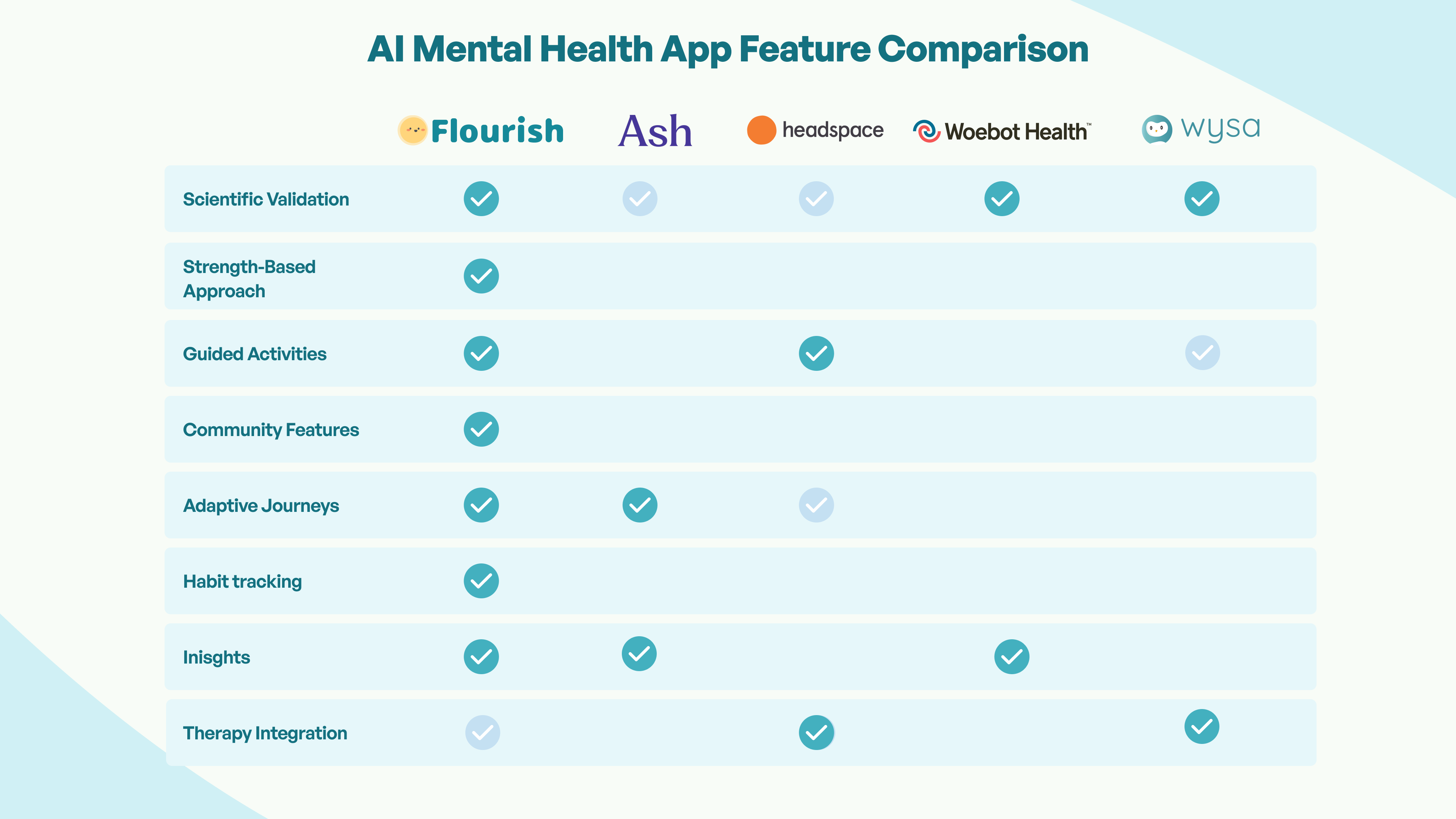
Built by psychologists and behavioral scientists, Flourish is a category leader in evidence-based, safety-first, AI-powered well-being support. Its effectiveness has been clinically tested in two large randomized controlled trials conducted with leading research institutions. The gamified mobile app combines emotional support, practical coping tools, and a joyful user experience—helping people build resilience, reduce stress, and cultivate a calmer, more grounded mind through meaningful daily actions.
Approach:
Flourish is an evidence-based, all-in-one well-being platform grounded in positive psychology, behavioral science, and affective and motivation science. It integrates evidence-based techniques from cognitive behavioral therapy (CBT) and acceptance and commitment therapy (ACT). Its AI well-being coach, Sunnie, provides 24/7 support for emotional wellness, stress management, habit building, and personal growth. Through personalized guidance, interactive tools, and a supportive community, Flourish delivers the right support at the right time. It is also frequently recommended by therapists as a between-session support tool.
Core Features:
Scientific evidence:
Flourish is the only Generative AI-powered mental health platforms supported by multiple randomized controlled trials (RCTs).
Best for:
People seeking a scientifically validated, user-friendly tool to support emotional well-being, particularly when experiencing stress, anxiety, depression, or major life transitions.
Limitations:
Flourish is not a replacement for therapy or crisis care and should not be used as the sole support for individuals experiencing high-acuity mental health conditions.
Best known for pioneering a global meditation platform with over 100 million of global active users, Headspace has evolved into a holistic mental health platform—now enhanced with Ebb, its AI companion. Ebb provides personalized meditations and reflective prompts 24/7. Combined with Headspace’s extensive library of mindfulness tools, it offers a robust, self-guided wellness experience.
Approach:
Ebb uses generative-AI to simulate supportive conversation and recommend personalized meditations. It adds a light conversational layer and guide to help users access Headspace’s extensive meditation and wellness content.
Core Features:
Scientific evidence:
Hadspace has plenty of observational studies validating the effectiveness of its mindfulness platform. However, Headspace has yet to conduct a study measuring the effectiveness of its AI companion, Ebb.
Best for:
People looking for an easy entry into meditation and stress relief, with the added bonus of conversational support.
Limitations:
Ebb is currently only available to individual subscribers (Headspace Core & Headspace Care) and is not included in employer-based Headspace plans (Headspace EAP). Its long-term memory and social features are relatively new and underdeveloped. While Ebb offers helpful, in-the-moment emotional support, it has yet to prove its clinical effectiveness among peer AI mental health chatbots.
Wysa combines a free chatbot for journaling and mindfulness with paid live coaching. Wysa has a full library of 150+ therapeutic exercises that users can unlock with a premium subscription.
Approach:
Wysa’s chatbot and paired coaching model aims to guide users through personalized journeys with an always-available platform.
Core Features:
Scientific evidence:
Wysa conducted a recent study evaluating its impact in a small sample of adults with chronic conditions (arthritis or diabetes) over four weeks. Participants who used the chatbot showed reductions in depression and anxiety compared to a control group, although no changes were observed in stress. While users generally reported positive experiences, some limitations—particularly around conversational quality—suggest that such tools may be helpful for some individuals but are not a complete solution. Find the study here.
Best for:
People looking for access to coaching / therapy sessions with unlimited messaging support and a library of mental wellness exercises.
Limitations:
Wysa does not offer persistent long-term memory across conversations in the way Flourish and some other apps do. While it provides guided exercises and mood check-ins, its free version includes a limited content library, and users have minimal access to structured insights or longitudinal progress tracking tied to personalized well-being goals.
Ash is an emerging AI-powered therapy experience designed to provide personalized, judgment-free emotional support. It is positioned less as a self-care toolkit and more as an always-on conversational companion grounded in therapeutic principles.
Approach:
Ash takes a voice-first, therapy-inspired approach, emphasizing natural conversation, emotional continuity, and reflection over time. The system supports both voice and text interactions, remembers prior conversations, and aims to surface emotional patterns across sessions. Rather than guiding users through structured programs, Ash focuses on ongoing dialogue that resembles aspects of a therapeutic relationship.
Core features:
Scientific evidence:
SlingshotAI has released an observational study (2025) reporting preliminary improvements in user-reported mental health outcomes. While the findings suggest potential benefits, the study has been criticized for lacking a control group and randomization. As such, the evidence should be considered early and exploratory, rather than conclusive clinical validation.
Best for:
Users seeking a therapy-like conversational experience, particularly those interested in voice-based interaction and continuous emotional companionship rather than structured skill-building or symptom-focused programs.
Limitations:
Liven combines AI-driven conversational guidance with mood tracking and structured journaling to support everyday mental wellness. It focuses on helping users build emotional awareness through personalized insights, daily reflection prompts, and habit-forming task recommendations.
Their approach blends self-guided behavioral tools with access to certified health professionals, creating a hybrid support model that balances automation with expert oversight.
They’re particularly strong for users looking to better understand emotional patterns and build long-term resilience through consistent, guided self-reflection and actionable well-being routines.
Woebot Health pioneered the CBT chatbot space with its chatbot that provides short, structured interventions with emoji check-ins and friendly GIFs. Woebot currently no longer offers a consumer-facing app and is shifting toward enterprise partnerships in healthcare.
Approach:
Woebot uses clinically validated, automated CBT responses—not generative AI.
Core Features:
Scientific evidence:
In 2021, Woebot had a successful FDA Breakthrough Device Designation for postpartum depression treatment (Press Release). Woebot has also demonstrated efficacy in an observational study validating its ability to reduce anxiety and depression in young adults. See the study here: Woebot 2021 Study
Best for:
Users wanting to learn CBT basics in a structured, low-pressure environment with extensive clinical validation.
Limitations:
No longer available as a direct-to-consumer app. Offers no peer support features and limited support for community connection.
Choosing the right AI mental health and wellness tool depends on what support you need at this moment. If you’re within the Headspace ecosystem already, Ebb is a perfect guide for the meditation platform with therapy integration. If you’re curious about emerging wellness tech, Ash is worth trying.
However, if you’re looking for the most comprehensive wellness support for yourself or a loved one that has been scientifically validated as effective, Flourish stands out as the clear choice. Its evidence-based approach helps individuals and communities feel better, do better, and connect better.
Whether you’re an educator, a student, a caregiver, or simply looking for small ways to improve your well-being, we invite you to explore what Flourish has to offer.
👉 Download the Flourish App and start your journey with Sunnie today!

A 10-question checklist to help leaders compare digital well-being tools for their population.
Read more ➔
Generative AI is reshaping emotional support, but few tools are purpose-built on rigorous psychological science. Here is what we learned from bridging the gap.
Read more ➔
AI chatbots are everywhere, but most are not built for mental health. Here’s what you can do.
Read more ➔



Email hello@myflourish.ai to join us in this exciting movement, share a personal story, or simply send some good vibes. Your voice means a lot to us!
